
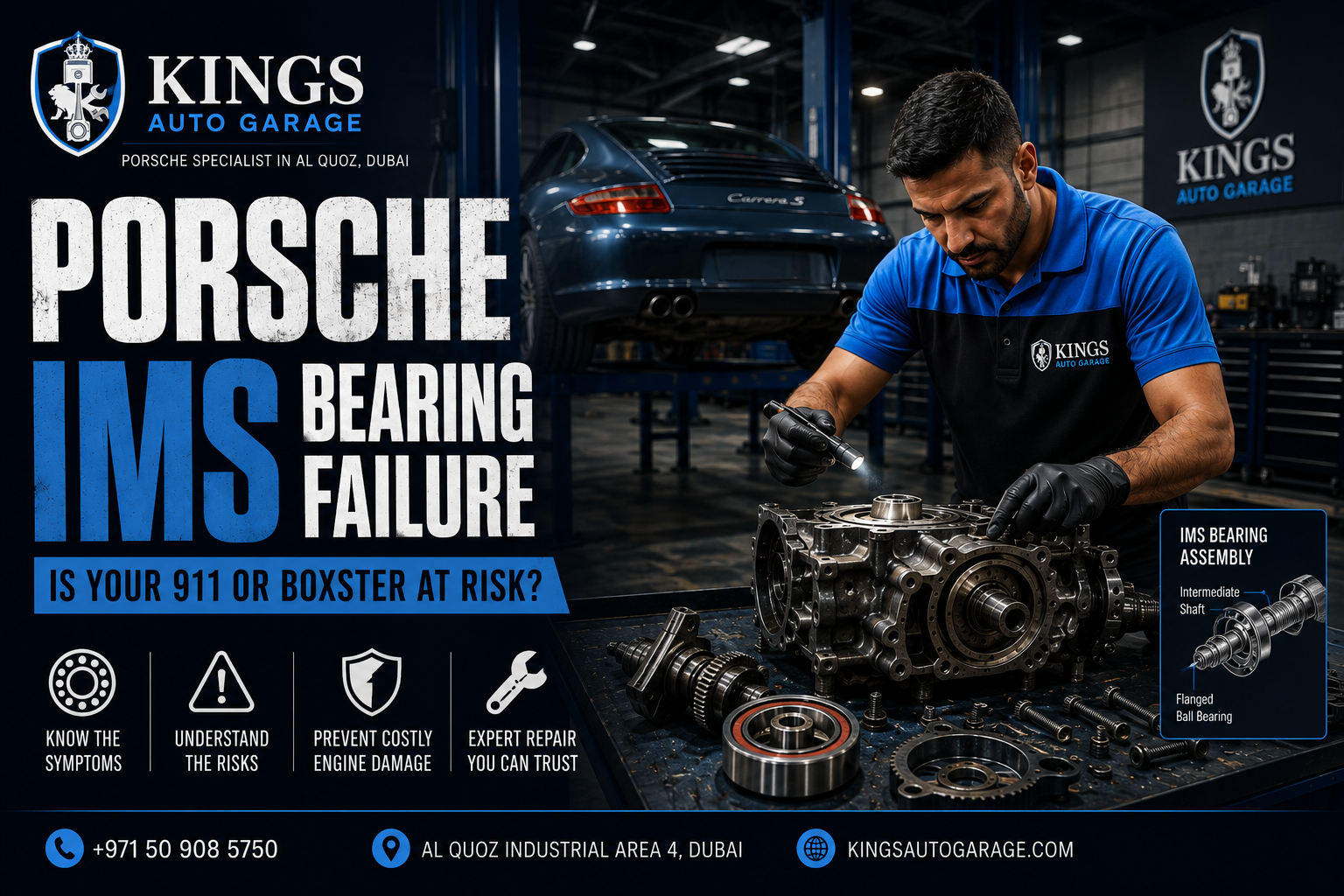
If you’re searching for Porsche IMS bearing failure Dubai, understanding this common issue is essential for protecting your Porsche 911 or Boxster from costly engine damage. The IMS (Intermediate Shaft) bearing has become one of the most discussed concerns among Porsche owners, particularly those with certain 911 and Boxster models. While not every Porsche is affected, recognising the warning signs and understanding the risks can help owners make informed decisions about inspections, preventive maintenance, and repairs. If you’re looking for Porsche repair Dubai or a trusted Porsche garage in Al Quoz, knowing the condition of your IMS bearing is an important part of maintaining your vehicle’s reliability and performance.
What Is an IMS Bearing?
The IMS (Intermediate Shaft) bearing is a critical component found in certain Porsche flat-six engines. It supports the intermediate shaft, which drives the camshafts and helps maintain precise engine timing.
Although relatively small, the IMS bearing plays a significant role in the engine’s operation. When it begins to wear or fails completely, the engine timing can be disrupted, potentially leading to catastrophic internal engine damage. In severe cases, the failure may result in bent valves, damaged pistons, broken timing chains, and even complete engine failure requiring an expensive rebuild or replacement.
Because of these risks, IMS bearing inspections have become an essential part of preventive maintenance for many Porsche owners.
Which Porsche Models Are Affected?
The IMS bearing issue mainly affects Porsche vehicles fitted with the M96 and M97 engines.
The most commonly affected models include:
Porsche 911 (996)
Produced between 1999 and 2005, the Porsche 911 (996) is one of the most recognised models associated with IMS bearing concerns.
Porsche Boxster (986)
The Porsche Boxster manufactured between 1997 and 2004 is also commonly affected.
Porsche Cayman (987)
Certain early Cayman models equipped with the M97 engine may also experience IMS bearing wear.
Porsche 911 (997.1)
Some naturally aspirated 997.1 models built between 2005 and 2008 also use the M97 engine and may be susceptible.
Fortunately, later Porsche models equipped with the redesigned 9A1 engine generally do not experience IMS bearing failures.
What Causes Porsche IMS Bearing Failure?
Several factors contribute to IMS bearing wear over time.
Normal Bearing Wear
Like any mechanical component, the IMS bearing naturally wears as the vehicle accumulates mileage.
Insufficient Lubrication
The original sealed bearing design relies on grease lubrication. As the grease ages and deteriorates, bearing wear accelerates.
Vehicle Storage
Porsche vehicles that remain unused for extended periods may experience bearing deterioration due to reduced lubrication movement.
Age
Even lower-mileage vehicles can develop IMS bearing problems simply because the original bearing has aged.
Common Symptoms of Porsche IMS Bearing Failure
Recognising the warning signs early can prevent expensive engine damage.
Metal Particles in the Engine Oil
During routine servicing, technicians may discover metallic debris inside the oil filter, indicating possible bearing wear.
Rattling Noise During Start-Up
A worn IMS bearing can produce a rattling or grinding sound when the engine starts.
Oil Leaks
Oil leaks around the rear main seal area may indicate the need for further inspection.
Engine Warning Light
Changes in engine timing caused by IMS bearing wear may trigger fault codes and illuminate the check engine light.
Poor Engine Performance
Drivers may notice rough idling, hesitation, reduced power, or occasional engine misfires.
Why IMS Bearing Failure Is a Serious Problem
Unlike many common engine issues, IMS bearing failure can occur suddenly and cause catastrophic damage.
If ignored, it may result in:
- Engine timing failure
- Bent valves
- Damaged pistons
- Broken timing chains
- Metal contamination throughout the engine
- Complete engine failure
Repairing an engine after IMS bearing failure is significantly more expensive than replacing the bearing as preventive maintenance.
Should You Replace the IMS Bearing Preventively?
Many Porsche owners choose preventive IMS bearing replacement before any symptoms appear.
This repair is commonly performed during:
- Clutch replacement
- Rear main seal replacement
- Flywheel replacement
Since the transmission must already be removed for these repairs, replacing the IMS bearing at the same time helps reduce labour costs while improving long-term reliability.
Whether preventive replacement is necessary depends on your Porsche’s model, mileage, age, and service history.
Porsche IMS Bearing Failure Dubai
If you’re searching for Porsche IMS bearing failure Dubai, it’s important to choose a workshop with extensive experience working on Porsche engines. At Kings Auto Garage, we specialise in diagnosing and repairing Porsche vehicles, including the Porsche 911, Boxster, Cayman, Panamera, Cayenne, and Macan.
As a trusted Porsche garage in Al Quoz, our technicians use advanced diagnostic equipment to identify IMS bearing issues before they lead to catastrophic engine damage. Whether your vehicle requires an inspection, preventive IMS bearing replacement, or complete engine repairs, our team follows manufacturer-recommended repair procedures to restore reliability and performance.
If you’re looking for Porsche repair Dubai, a reliable Porsche workshop Dubai, or the best Porsche garage in Al Quoz, Kings Auto Garage offers dealership-quality expertise with personalised service.
How Is IMS Bearing Failure Diagnosed?
Experienced Porsche technicians use several methods to determine the condition of the IMS bearing.
These include:
- Inspecting the oil filter for metallic debris.
- Checking engine timing fault codes using Porsche diagnostic equipment.
- Reviewing previous service records.
- Inspecting the IMS bearing directly when the transmission is removed.
Early diagnosis allows technicians to identify developing problems before they become major engine failures.
Can IMS Bearing Failure Be Prevented?
Although no mechanical component lasts forever, proper maintenance can help reduce the risk.
Recommended preventive measures include:
- Following Porsche-recommended oil change intervals.
- Using the correct engine oil.
- Avoiding long periods of vehicle storage.
- Investigating unusual engine noises immediately.
- Having regular inspections performed by a Porsche specialist Dubai.
Routine maintenance cannot guarantee that the IMS bearing will never fail, but it greatly improves the chances of detecting problems early.
Why Choose Kings Auto Garage for Porsche Repairs?
Choosing the right workshop is essential when maintaining a high-performance Porsche.
At Kings Auto Garage, our experienced technicians specialise in servicing Porsche vehicles using advanced diagnostic equipment and manufacturer-approved repair procedures.
As a trusted Porsche specialist Dubai, we provide:
- Porsche diagnostics
- IMS bearing inspections
- Preventive IMS bearing replacement
- Porsche engine repair Dubai
- Cooling system repairs
- Transmission repairs
- Suspension repairs
- Routine Porsche maintenance
- Complete Porsche servicing
Whether you drive a Porsche 911, Boxster, Cayman, Panamera, Macan, or Cayenne, our technicians are committed to delivering exceptional workmanship.
If you’re looking for the best Porsche garage in Al Quoz, Kings Auto Garage combines technical expertise with outstanding customer service.
Final Thoughts
IMS bearing failure remains one of the most discussed issues affecting certain Porsche 911, Boxster, and Cayman models. While not every Porsche will experience this problem, recognising the warning signs and taking preventive action can save thousands in future repair costs.
If you’re concerned about Porsche IMS bearing failure Dubai, schedule a professional inspection with Kings Auto Garage. As a trusted Porsche workshop Dubai, Porsche garage in Al Quoz, and provider of Porsche engine repair Dubai, we offer expert diagnostics, preventive maintenance, IMS bearing inspections, and complete engine repair services. Our experienced technicians are dedicated to helping Porsche owners protect their investment and enjoy reliable performance for years to come.
Frequently Asked Questions
IMS bearing failure occurs when the intermediate shaft bearing in certain Porsche engines wears out or breaks down. If left unchecked, it can lead to serious internal engine damage and, in severe cases, complete engine failure.
IMS bearing issues are most commonly found in Porsche 911 (996), Boxster (986), early Cayman (987), and certain 997.1 models equipped with M96 and M97 engines.
Common symptoms include metallic particles in the engine oil or oil filter, rattling noises from the rear of the engine, oil leaks near the rear main seal, engine warning lights, and occasional engine misfires.
No. If you suspect IMS bearing issues, it is best to avoid driving the vehicle until it has been inspected by a Porsche specialist. Continued driving may result in extensive engine damage.
Yes. Many Porsche owners choose preventive IMS bearing replacement, especially when the transmission is removed for clutch or rear main seal replacement.
No. The issue mainly affects certain Porsche models fitted with M96 and M97 engines. Newer Porsche models equipped with the 9A1 engine design are generally not affected.
Factors such as bearing wear, ageing components, insufficient lubrication, and prolonged periods of inactivity can contribute to IMS bearing failure.
Diagnosis may involve inspecting the oil filter for metal debris, checking for fault codes, reviewing service history, and performing a physical inspection when the transmission is removed.
Yes. A pre-purchase inspection by an experienced Porsche specialist Dubai can help determine the vehicle’s condition and whether the IMS bearing has already been upgraded or replaced.
You can visit Kings Auto Garage for Porsche IMS bearing failure Dubai inspections and repairs. As a trusted Porsche garage in Al Quoz, we provide Porsche diagnostics, IMS bearing inspections, preventive maintenance, and complete Porsche engine repair services for all Porsche models.
 Oil Changes
 Suspension Repair
 Brakes Repair
 ECU/ECM Repairs
 AC Repair
 Battery Replacement
 Car Inspection